
Autoclaved aerated concrete (AAC) is increasingly gaining market dominance due to its many outstanding advantages such as: ultra-lightweight, excellent sound and heat insulation, superior fire resistance, fast construction, and cost savings… However, to better understand this non-fired building material, let’s explore the production process of autoclaved aerated concrete bricks and slabs, from raw materials to finished products, with EBLOCK!
1. Autoclaved aerated concrete (AAC) brick manufacturing process
The production process of autoclaved aerated concrete (AAC) bricks is a closed-loop, automated system using German technology, resulting in superior product quality. Each stage is closely monitored, from raw material selection to finished product. Specifically, the AAC brick production process is as follows:
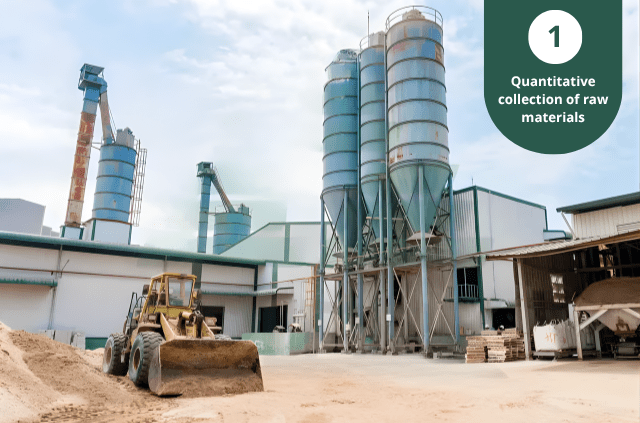
1.1 Quantitative collection of raw materials
The main raw materials are transported to the factory by various means. Sand is transported by barge along the Vam Co Dong River and transferred to the sand storage area within the factory grounds, or by road when necessary. Lime is mainly transported by river, and gypsum is transported by road. Within the factory grounds, each raw material storage area is designed separately.
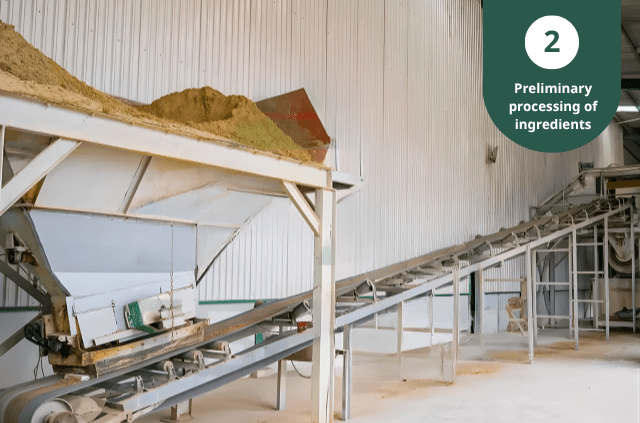
1.2 Pre-processing of ingredients
Sand is fed into a crusher to ensure the fineness of the sand particles. The sand is crushed together with water. After crushing, the sand + water solution is transferred to a solution tank. Cement is imported in powder form (bulk cement), and cement tankers pump the powdered cement directly into the cement storage tank. Lime is also crushed into powder and stored in a tank before being mixed into the solution. Gypsum is in powder form and stored in a tank. Aluminum powder is imported in small quantities and loaded into an aluminum powder storage tank.
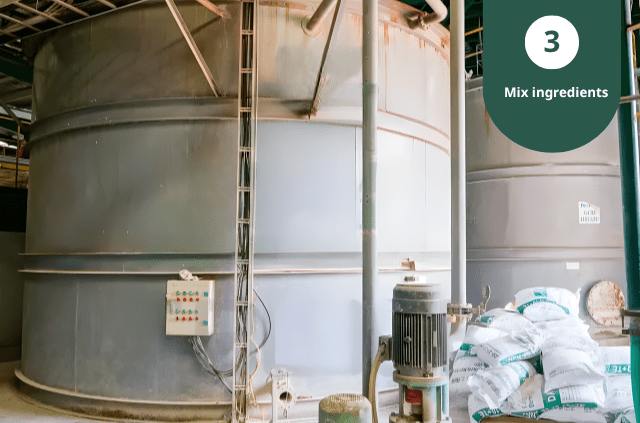
1.3 Mixing the ingredients
After initial preparation, all ingredients are transferred to the mixing stage. This stage is completely automated. A computer controls the moisture and temperature of the mixing bowl, adds each ingredient in the correct order and proportion, and then controls the amount of water added to the mixture, the mixing speed, and the mixing time to obtain the best possible mortar solution.
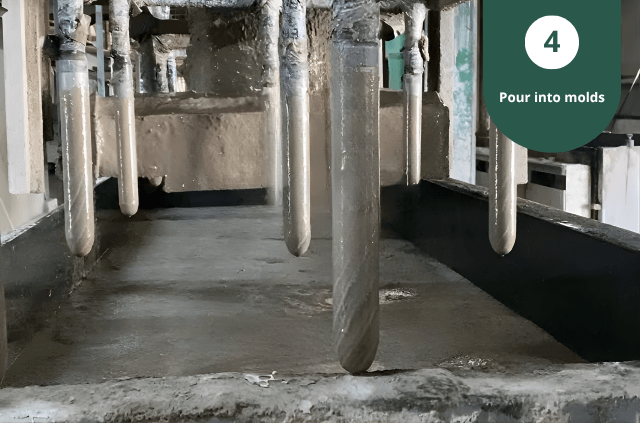
1.4 Pour into mold
After the mixing process, the mortar solution is ready for pouring. The solution is poured into the mold in a volume calculated automatically by the system. The mold is placed on a pouring cart, and its movement in and out of the pouring area is also pre-programmed and performed completely automatically.
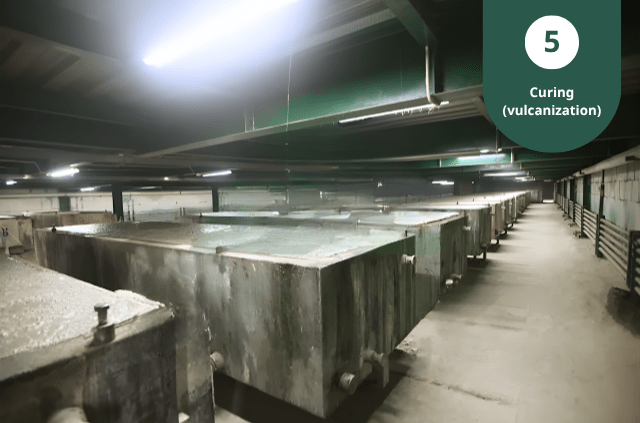
1.5 Curing
After the solution has been poured into the mold, the mold is placed in a curing chamber, where the temperature is maintained at approximately 40-50 degrees Celsius. Here, a reaction occurs between calcium hydroxide in the slaked lime and aluminum powder, producing hydrogen gas. As a result, the solution in the mold increases in volume due to the millions of gas bubbles inside. The curing time lasts approximately 2-3 hours.
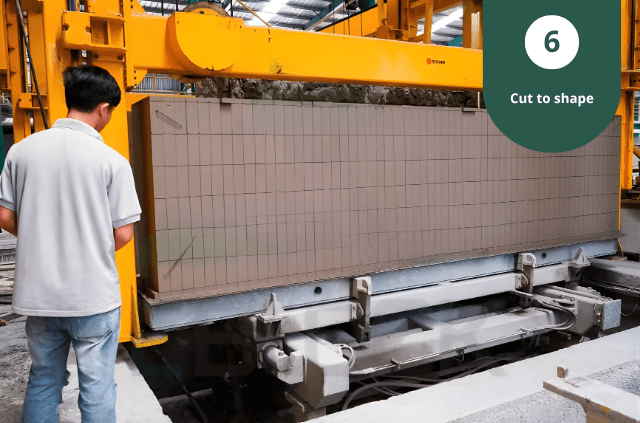
1.6 Shaping and Cutting
After the vulcanization process is complete, the hydrogen release reaction finishes, and the solution forms a cake with a certain consistency. The autoclaved aerated concrete (AAC) cake is then fed into a cutting machine. The cutting machine is pre-set to the desired brick size and is fully automated. Because the outer surfaces must be cut, this process generates excess cake material (slurry waste). This waste falls into a groove beneath the cutting machine, is transferred to a collection pit, is finely ground, and pumped back to the waste slurry tank for the mixing and pouring process.
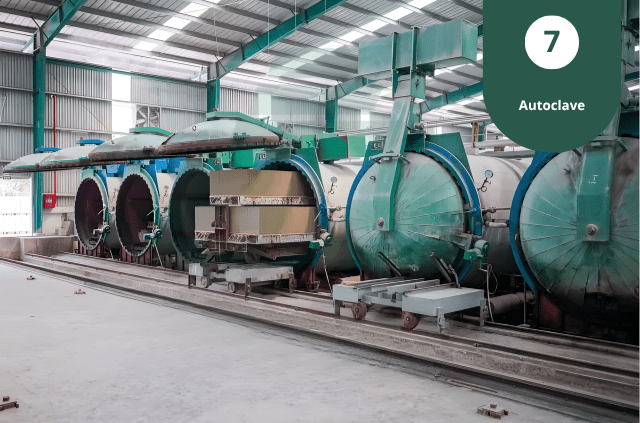
1.7 Steaming
After the cutting process is complete, the cake is placed in a steaming chamber. The steaming chamber is made of steel, with a diameter of 2m and a length of 32m. Steam is supplied from boilers and introduced into the chamber. Inside the chamber, the air is initially removed to create a vacuum, then the pressure and temperature are increased to approximately 180°C, with the pressure maintained at around 12 kg/cm². The entire steaming process lasts about 10-11 hours to ensure the AAC bricks achieve optimal hardness.
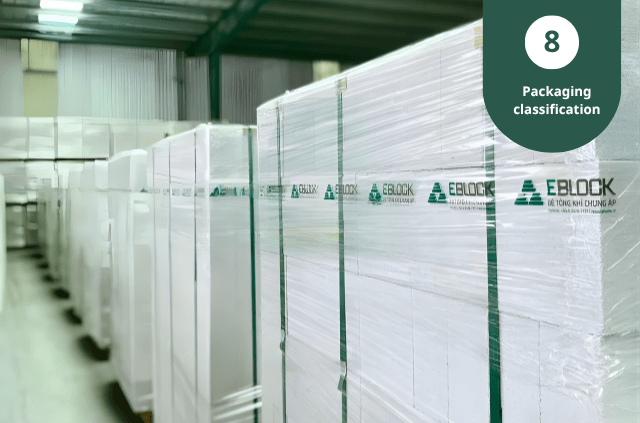
1.8 Packaging classification
After the autoclave curing process is complete, the autoclaved aerated concrete blocks are removed from the curing chamber for sorting and packaging. The blocks are placed on pallets, packaged, labeled with the production date and batch number, and then moved to the finished product storage area. EBLOCK applies a strict quality control process according to European standards to all products leaving the factory to ensure that each block arrives at the construction site in the best possible condition.
Lightweight, heat-resistant bricks like autoclaved aerated concrete (AAC) have opened up a modern construction solution with many outstanding advantages that traditional red bricks cannot offer. You can learn more in our previous article HERE.
2. Autoclaved Aerated Concrete (AAC) Slab Manufacturing Process
Both AAC EPANEL panels and autoclaved aerated concrete blocks are made from autoclaved aerated concrete. However, the biggest difference is that ALC lightweight concrete panels have an internal steel reinforcement layer, which increases their load-bearing capacity, while blocks do not have this steel layer.
Therefore, the production process for bricks and slabs is quite similar. However, AT STEP 1.4, before pouring the solution into the mold, the mold is reinforced with a steel mesh (cut, welded, and treated with anti-rust coating) beforehand. The subsequent production steps are carried out similarly as above.
Refer to the image below for a better understanding of EBLOCK’s autoclaved aerated concrete (AAC) manufacturing process.
AAC EPANEL panels manufactured at the EBLOCK factory.
If you are looking for high-quality, energy-efficient, cost-effective, and environmentally friendly building material solutions, please contact us immediately at (+84) 888 69 4499 or Contact us for advice and a quote on the best autoclaved aerated concrete (AAC) product for your project!
Contact us for consultation:
– ☎ (+84) 888 69 4499
– ✉️ info@aac-block.com
Address: 330/72/31 Le Duc Anh Street, Binh Tan Ward, Ho Chi Minh City